
Original text in Chinese below.
Text edited and translated by: Promise Xu, SHEN Wei

Hope (3 Parts), 2022-2023
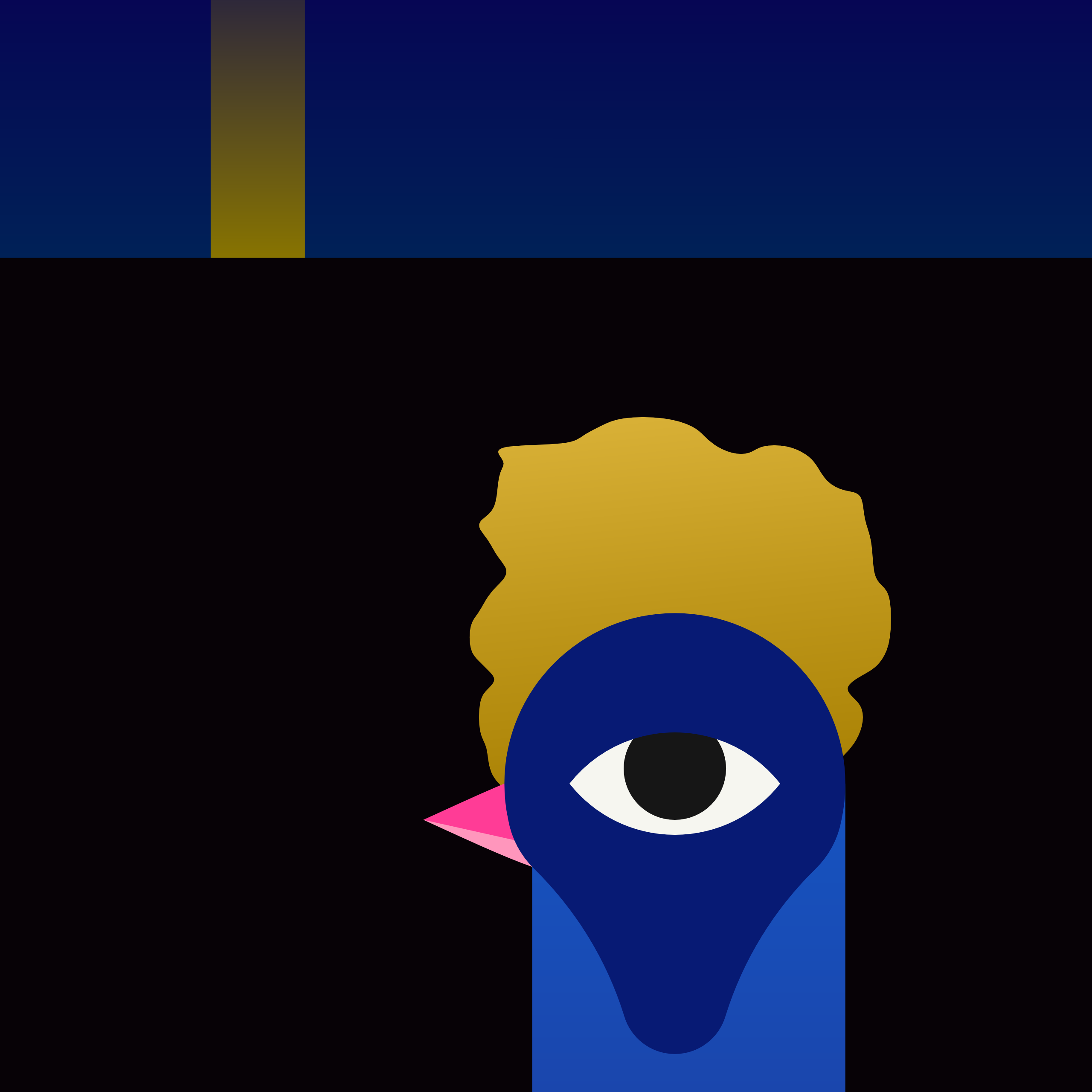
The theme of the main visual is “hope”. In philosophy, the construct of “hope” includes two elements that are independently necessary and jointly sufficient: (A) the hoped outcome must be desired by the hoper, and (B) the outcome falls within a range of physical possibility (not for certain but also not logically impossible, though it can be improbable[1]). The latter distinguishes “hope” and “optimism”—while “optimism” also requires the desire in (A), it needs, more than (B), a belief that the outcome is more likely than not. The above definition of hope is not without objections. Some believe that in order to hope one has to affectively engage with the outcome[2]. Shen Wei, our Artistic Director explained it well: “I’m a pessimist but I’ve decided to embrace hope. I want good things to happen in the future, so I will do everything to make it happen. I don’t believe in obtaining positive final results but I believe in the process of doing what I can to achieve good results.”
The first part of Hope (3 parts) emphasizes a duality. The image depicts a clapperboard, rendered in 2-dimension, and a container in 3-dimension. Within the container, there is a sphere with what looks like a video play button. If the clapperboard belongs to the filmmaker, then the play button belongs to the audience. The second part of the work shows the full opening of the container, with its content bursting out. The third part shows that the container is not closed in the end, but instead fully opened, with nothing in it.
The work draws inspiration from the myth of Pandora’s box. First recorded in Hesiod’s Works and Days, it was told that Prometheus enraged Zeus for stealing fire from heaven, and Zeus, in retaliation, put Pandora’s box onto earth as a punishment. When Pandora opened the box, various curses were released. She quickly closed the box, and only “Hope” (Elpis) remained inside. There are many competing interpretations of this story, while the myth itself also has multiple different versions.
First of all, was there only curses in the box? Some hinted the exact opposite. In an engraving by Renaissance artist Giulio Bonasone (currently in the collection of MET), Epimetheus, Pandora’s husband, opened a large jar, and female goddesses representing the Roman virtues flied out, while only Spes (the Roman counterpart of Elpis, also representing hope) lingered at the lip.
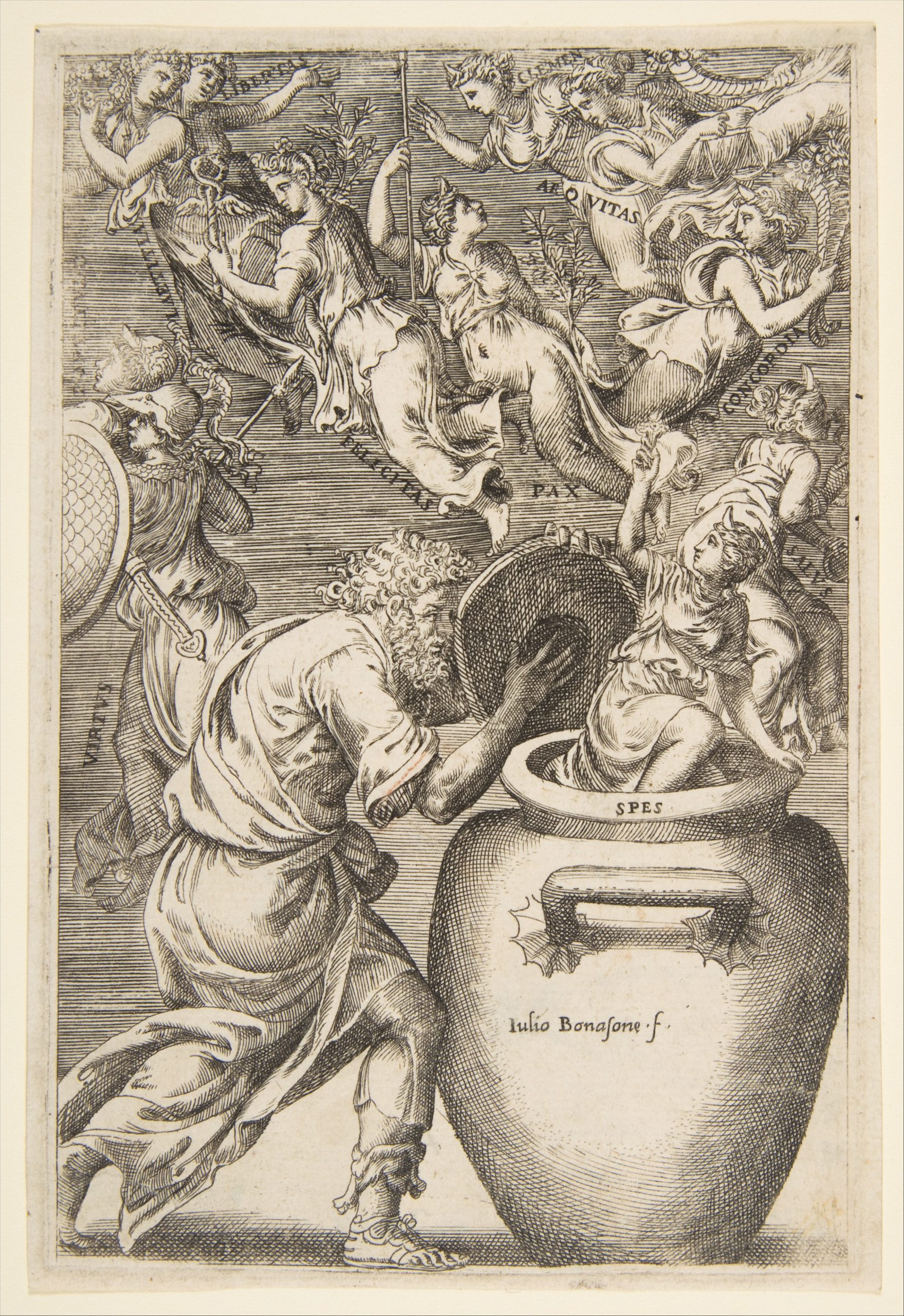
Epimetheus Opening Pandora’s Box
Engraving, 17.2 × 11.6 cm
Second of all, is “hope” a blessing or a curse? If “hope” is a blessing, why was it kept in a box of curses? The ancient Greek word “elpis” can also mean “expectation”, which can have positive, neutral, or negative meanings. Even if it is translated into “hope”, its interpretations are subject of debates in philosophy—even in Plato’s works there are ambivalences. Some pointed out that hopes can be false, which lead to the irrationality of man. Nietzsche further argued that, human beings are tormented with all kinds of evils, and hope keeps them staying alive to be tormented even more, and is thus the most evil of evils.
Furthermore, is it good or bad that “Hope” is kept in the box? The role of the box should be considered: was it to keep things available for man, or to imprison things away from man? When the box was opened, did the content escape from mankind, or enter into the world? Therefore, every turn of the myth can have at least two interpretations, eventually leading to a more optimistic or pessimistic conclusion. For example, if in the box there were curses and “Hope”, which was a blessing, the retention of “Hope” in the box could mean that human race preserved hope despite the widespread release of evils, or it could mean that man got all kinds of curses while hope was withheld from them.
Lastly, what does “hope” mean to our festival? Is it a blessing or a curse? Will it bring suffering or joy? To many, a film festival is an occasion to celebrate and to be inspired—cinephiles get to see new films and interact with filmmakers—how exciting and fun! Yet, in the lonely journey of creating art, all true artists, to one degree or another, have experienced the “darkest hour”: something would always, always go wrong…if only I could get another take…Nobody is ever certain about every decision, no matter how experienced they are.
The artist walks alone—under the starry sky or the scorching sun, through the mist or the glow, by the clear creek or the unknown abyss—yet, the artist walks on. The smell, the breeze, the soundless night—what wonders the artist could draw and leave behind. Yet, the artist walks, still. Until they are or the world is no more. Against mortality. To eternity. And we also walk on, for in the walk there is hope, and everything else.
Footnotes:
- See R. S. Downie’s essay Hope ↩︎
- See Philip Pettit’s theory on “substantial hope” and Cheshire Calhoun’s theory on “phenomenological idea” ↩︎
为第三届木兰国际电影节创作的主视觉作品的主题是“希望”。哲学上一般定义“希望”包含两个要素:(一)产生希望的人对所希望的结果能实现的欲望,以及(二)该结果具备可能性(不是完全确定的,也不是逻辑上不可能的,但可以是不大可能的[1])。第二个要素区分了“希望”和“乐观”——“乐观”同样包含欲望,但同时,人须相信结果有较大可能性实现。其实,上述对“希望”的定义也有局限,一些学者指出,要去希望,人还需要在情感甚至行动上参与进来[2]。我们的艺术总监沈玮很好地解释了这一点:“我是个悲观主义者,但是我决定拥抱希望。我希望未来有好事发生,所以我将全力以赴让它发生。我并不相信终将获得好结局,但我相信尽我所能、取得好结果的过程。”

Hope – Part I, 2022-23
《希望(三联)》的左翼面强调了二元性。画面中下方有一个平面的场记板和一个立体的方形容器,容器内有一个播放按钮外观的球体。如果场记板属于创作者,那么播放按钮属于观众。作品中间面为容器完全打开,内里之物迸发而出。右翼面的容器则彻底敞开盖,里面不再有任何东西。
作品的创作灵感来自于潘多拉魔盒神话。这个神话最早记录在赫西俄德的《工作与时日》诗中。相传普罗米修斯为人类盗取火种激怒了宙斯,宙斯为了惩罚人类将潘多拉的魔盒放到人间。当潘多拉打开魔盒时,各种不幸的事物跑了出来,她赶紧关上魔盒,只有“希望”(Elpis)留在了里面。人们对于整个事件的解读众说纷纭,而神话本身也有很多其他版本。

Hope – Part II, 2022-23
首先,魔盒里装着的一定是不好的东西吗?一些传说记载了相反的故事。在文艺复兴时期画家朱利奥·博纳松的一幅版画(现收藏于大都会艺术博物馆)中,潘多拉的丈夫厄庇墨透斯打开了一个大罐子,代表和平、公正、自由等的女神们飞了出来,唯有Spes(罗马神话中的Elpis,也代表希望)留在了罐口。
其次,“希望”一定是好的吗?如果“希望”是好的,为什么它会跟其他不好的东西存在于同一个魔盒中?希腊语中“Elpis”一词也可以翻译为“预期”(expectation),它本身带有褒义、中性和贬义三种感情色彩。即使翻译为“希望”,在哲学中它的好坏也颇有争议,这甚至在柏拉图的著作里都存在矛盾。一些学者指出,“希望”可以是虚假的,从而使人变得不理性,而尼采更是认为,人类本来就要受苦,“希望”使人坚持活下去而受更多苦,因此是邪恶中的邪恶。
再者,“希望”被关在魔盒里是好事还是坏事?这需要考虑魔盒的功能——它是用来保存留给人类的东西,还是用来禁锢不该进入人间的东西?打开魔盒,里面的内容是逃离了人类,还是进入了这个世界?所以,这个神话故事的每一个环节都可以有至少两种解读,而最终则会得出偏乐观或偏悲观的结论。比如,如果魔盒里装的是灾难,而“希望”是好的,它最终被关在魔盒里可以象征人类留住了希望,也可以代表人类获得了灾难却没有获得希望。
最后,对于木兰而言,“希望”究竟是什么呢,是好还是坏,是苦还是乐?电影节在很多人看来,是热闹绚烂鼓舞人心的。观众们看到了新鲜的作品,有机会与电影人交流,这之中有太多欢愉和激动。然而,在创作的过程中,作者们多多少少都经历过某种“至暗时刻”。一定会有什么出了差错。如果这里能再来一遍,就好了。没有人对自己的决定从头到尾都有十足的信心,即便有再多的经验,也可能还会有心悬着的那刻。
走走停停,拿起又放下,合上又打开,回头再回头,踯躅前行。万法皆空,因果不空。“希望”存于这因与果之间。
脚注:
- 见R. S. Downie的论文《Hope》↩︎
- 见Philip Pettit的“substantial hope”和Cheshire Calhoun的“phenomenological idea”理论 ↩︎

Hope – Part III, 2022-23