Original text in Chinese below.
Text on Flower and a Lone Chair written by: Promise Xu
It seems that every nascent school of thought or movement must, at its inception, face accusations of deviance, or even bear the stigma of heresy — a dynamic particularly evident in the history of art. Impressionism, for instance, was at first dismissed by the prevailing French academic establishment; works by Monet and his contemporaries were rejected by the Salon. Yet, as we now know, this once-scorned form of painting rose to reshape the course of modern art, while the French Academy’s authority quietly eroded.
On the other end of Europe, the spirit of academic orthodoxy and the technical grammar once embodied by the French Academy found a new incarnation. In the young Soviet Union, cultural authorities drew upon realist traditions and inherited pedagogy to forge an official style: Socialist Realism. Conceived as art of and for the people, it became a totalizing system of aesthetics, theory, and values encompassing painting, literature, music, and more — ultimately the official consciousness of the Soviet regime.
Under Socialist Realism, art was bound to the service of ideology. Its content was to affirm the Communist Party and the Soviet state, its subjects drawn from the working class and the rhythms of daily life. Art’s value and purpose were redefined — to expose the cruelty of feudal servitude and capitalist exploitation, to glorify the radiant socialist future, and to celebrate the triumph of the proletarian revolution. Works that failed to serve this purpose faced censorship, the loss of commissions, exclusion from official artistic life — and, during Stalin’s era, their creators were often silenced, imprisoned, or even executed.
After Stalin’s death, Khrushchev rose to power and initiated the policy of de-Stalinization. The suffocating pressure on cultural life eased — a period that came to be known as the Khrushchev Thaw. Artists began to experiment anew, creating with a revived sense of multiplicity and engaging more openly with the world beyond Soviet borders. It was during this brief thaw that Andrei Tarkovsky — later revered as one of the most profound and influential filmmakers in history — entered film school and encountered the masterpieces of Western cinema that would forever shape his vision.
Yet the Thaw proved short-lived. When Khrushchev, during a visit to an avant-garde exhibition, vehemently criticized the paintings on view, the so-called Manege Affair marked the symbolic end of this fragile springtime of freedom. But by then, Soviet culture had already undergone an irreversible mutation: beneath the surface, discontent with Socialist Realism was crystallizing into what would become the Soviet Nonconformist Art movement — a clandestine, defiant current of creativity that rejected official doctrine. Its historical significance cannot be overstated. As Russian art historian, curator, and critic Joseph Backstein observed: “All of Soviet society rested on orthodoxy, and nonconformism was its enemy. That is why even the conditional and partial legalization of nonconformism in the mid-1970s was the beginning of the end of the Soviet regime.”
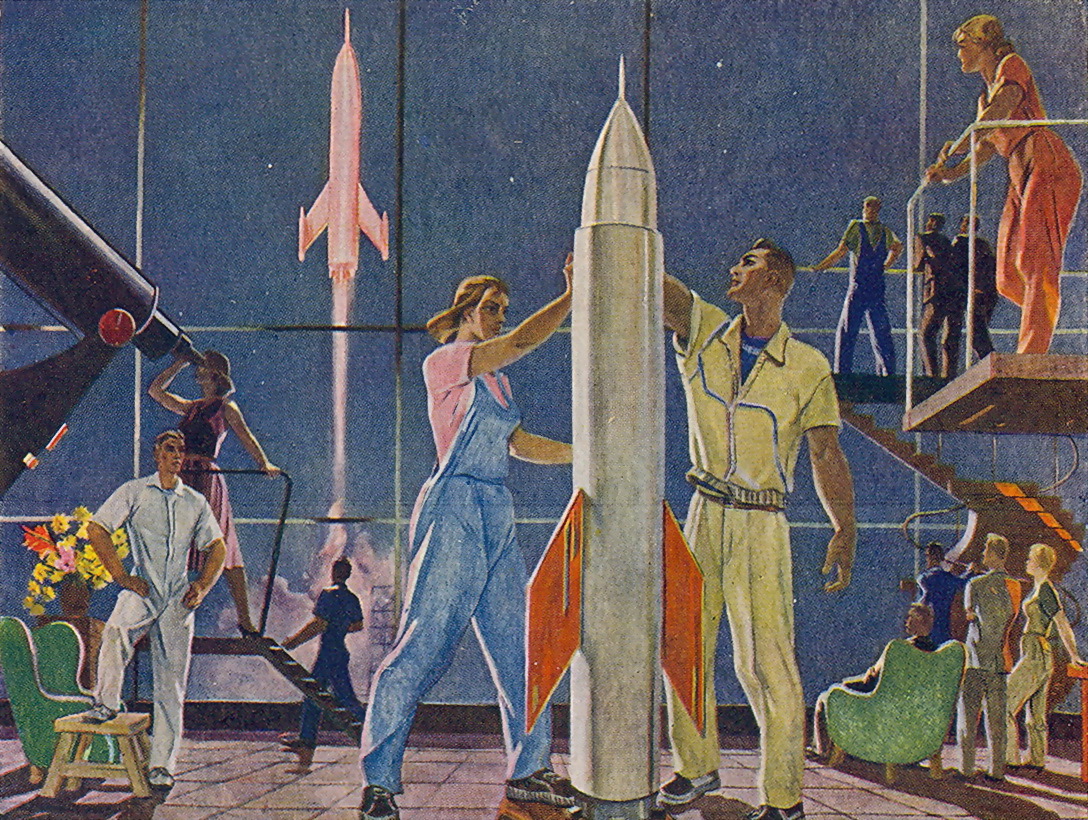
Conquerors of Space, 1961
Oil on canvas, 340 × 435 cm
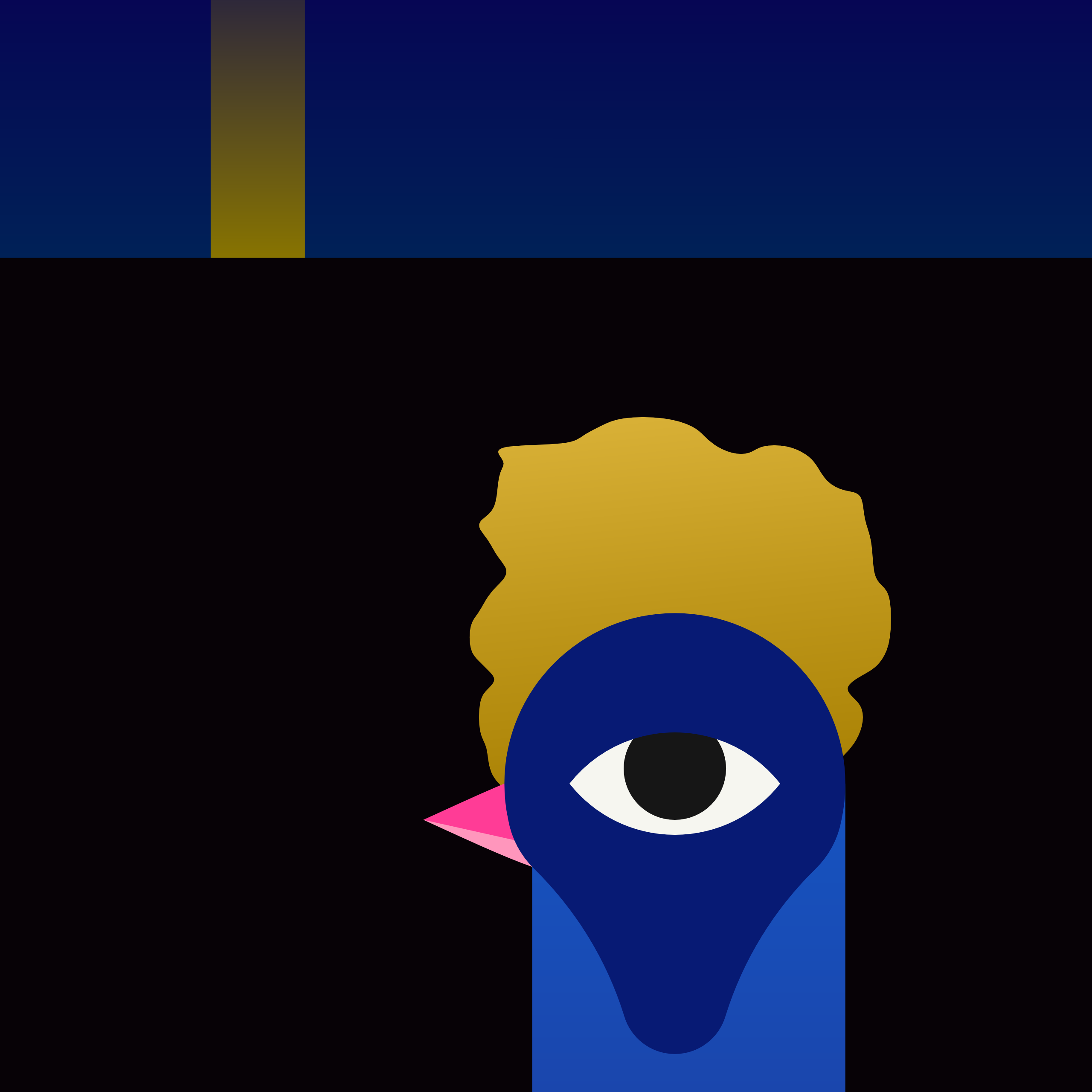
An Explosion at a Cosmodrome extends the right side of Aleksandr Deyneka’s 1961 Socialist Realist monumental painting Conquerors of Space — transforming what was once a triumphant hymn to the Soviet space program into a new, subversive vision. Here, a massive, imagined explosion, conceived from the painter’s own vantage point, is appended to the pictorial scene, rendered in the pixelated idiom of the digital age.
Flower and a Lone Chair is a further, more visionary variation—a meditation on aftermath and witnessing. If such an explosion were to happen — and how could it not? — would there not be a curious, defiant soul who happens to see it, to capture it? Or perhaps, a lone director who steps inside, undeterred by peril or impossibility, only to glimpse the truth? Would there not be such a chair—such a solitary chair within each of us—standing still before the blast? In the moment of being utterly alone, utterly honest with oneself; in the moment you try to observe, trace, and seize it all—does the chair not become you? Does it not be you?
This pixelated explosion mirrors all that is true—art, love, or perhaps simply a flower. It is beautiful and perilous, immense and fleeting, blazing like fire, rushing like wind. The world may attempt to conceal it, to soften, censor, or pixelate it—but such efforts are futile. It may reveal itself to you for only an instant, yet that instant is enough: everything is changed. The explosion pierces every wall and darkness, leaving behind only rubble and reverberation.
If the flower is the eternal law of the universe, then the lone chair is you, and me, and all who have dared. The lone chair is Prometheus stealing fire, the pillar of salt beyond Sodom, Orpheus glancing back in the underworld. We are impermanent by nature—how could we be bound by doctrines masquerading as eternity? If to see, to record, to look back is nonconforming, then nonconforming is inevitable.
The explosion will always come; it has never been absent. Even as new walls rise, the chair remains.
任何新的事物和思潮似乎都难以避免在诞生之初被贴上离经叛道的标签——在艺术史上尤为突出——例如印象派刚开始不被当时主流的法国学院派接纳,莫奈等人的作品一度被沙龙拒展。但最终如我们所看到的,印象派这一崭新的艺术形式崛起,法国学院派丧失了主导地位。
而在欧洲的另一端,曾由法国学院派所体现的学术正统精神与技法体系以新的面貌重生。苏联负责文化与艺术事业的官员们汲取现实主义传统与继承的教学法,发展出有别于资本主义世界的社会主义现实主义及其配套理论和价值观,涵盖艺术、文学、音乐等各个方面。由此,它成为了苏联国家文化的官方意志。
在社会主义现实主义之下,权力机构通过严格的规范和审查制度,要求艺术的内容支持苏联共产党和国家的主张,艺术题材要与工人阶级和日常生活相关,艺术的价值及目的被定义为揭露封建奴役制和资本主义的残酷性、歌颂和畅想美好的社会主义未来和服务无产阶级革命的胜利——不符合这个目的的作品,其创作者不仅会遭到审查、失去委托与被排除在官方艺术生活之外——在斯大林时代更常被噤声、监禁甚至处决。
斯大林死后,赫鲁晓夫上台并开始在各个层面实行“去斯大林化”政策。苏联的文化界此前所受的监控和压迫因此得到了一些缓和,史称“赫鲁晓夫解冻”。艺术家们开始可以创作更多元的作品,也有机会和国外交流。被视为电影史上最具影响力的导演之一塔尔科夫斯基,正是在此时期进入电影学院,接触到西方大师的作品,从中获得了创作灵感。
虽然“赫鲁晓夫解冻”好景不长——这位领导人在一次参观前卫艺术展时愤怒地斥责作品“画得像屎一样”,该事件被认为是文化解冻结束的导火索——但苏联的文化生态已经发生了不可逆的转变:不满社会主义现实主义的艺术创作暗流涌动,形成了“苏联非官方艺术”(或称“非顺从艺术”)运动。该运动的历史意义是极其重大的——俄罗斯艺术史学家、博物馆长和艺术评论家约瑟夫·巴克斯坦(Joseph Backstein)这样描述:“整个苏联社会都建立在正统之上,而任何不遵循正统观念的思想都是它的敌人。正因如此,即便在20世纪70年代中期对‘非顺从艺术’进行有条件、部分的合法化,也标志着苏联政权的末日开始了”。
《航天发射场的一次爆炸》(An Explosion at a Cosmodrome)对苏联著名艺术家亚历山大·杰伊涅卡(Aleksandr Deyneka)1961年赞美太空计划的社会主义现实主义油画《太空征服者们》(Conquerors of Space)进行了展开,拓展了画卷的右侧,用像素画的风格描绘了一场从画家视角可以看到的爆炸。
《花和独椅》(Flower and a Lone Chair )则是更进一步的、畅想式的一个变奏:如果真有一场这样的爆炸——难道真的会没有吗?——是否会有一个好奇又反叛的灵魂恰好能看到、捕捉到这一切?抑或说,是否会有一个无视千般险阻与不可能、孤身入内的导演,只为一睹真相?是否会有这样一把独椅、每人心中的一把独椅,在你面对爆炸时静立于此?在你绝对独自一人、绝对诚实于自我的时刻,在你试图观察、描摹与抓住这一切的时刻,它变成了你、它便是你?
这个像素化的爆炸,恰似一切真理、艺术与爱——又或者是花,它美丽而又危险,声势浩大到无远弗届却又转瞬即逝、如火如风,世间的种种妄图将其遮盖、粉饰、打上马赛克——这当然只是徒劳,它或许只为你展露一瞬,但只消这一瞬,一切便已改变——这爆炸穿透一切高墙与黑暗,它留下一地瓦砾与轰鸣。
若花是宇宙不变之常理,那这独椅便是你我他——这独椅是盗火的普罗米修斯,是不遵神谕、索多玛之外的人形盐柱,是冥府中回头的俄耳甫斯——你我本就是无常,又怎么可能被那些伪装作永恒的教条所束缚?如果去看、去记录、去回望便是叛逆,那么叛逆便是必然。
爆炸总会来,爆炸从未缺席——纵使爆炸后总有新的高墙,但这把椅子也一样。